Our human minds did not evolve immediately to understand large numbers. Many ancient humans thought the stars were mere ‘dots’ in the sky that were easily reachable, leading some to create structures in order to reach them. As cultures evolved, so did mythology, which is abundant in stories such as the ancient Greeks, who thought that the god Zeus transformed Seven Sisters into the star cluster, the Pleiades — or the early Egyptian Pharaohs, who were buried in majestic pyramids, so that after death, they would ascend vertically and literally “jump off” into the cosmic after life.
Today, we know that 1.3 million Earths can fit into one ‘mere’ dot in the sky, or 7 quadrillion Earths (7,000,000,000,000,000) into the red massive hypergiant, VY Canis Majoris.
Many of us still don’t have a working knowledge of the scale of the cosmos. Perhaps some of us don’t care. Perhaps some fear the cosmos, considering it a taboo against their beliefs. Perhaps some fear astronomical numbers or just simply don’t know where to begin. This blog post is a collective of tools to easily help one begin to grasp the scale of the universe. Understanding the universe is a character building experience. One becomes humbled when contemplating the vastness of the universe, seeing that it is borderless, that the Earth itself is borderless. Man-made culture wars and the arrogant treatment towards one another will become senseless. To see out into the cosmos is to see within. These tools will help you grasp the scale of the universe but be forewarned, your mind once stretched, will never return to its original dimensions:

“You have to take seriously the notion that understanding the universe is your responsibility, because the only understanding of the universe that will be useful to you is your own understanding.” ―Terence McKenna
This post is categorized in two sections: VIDEO and INTERACTIVE. VIDEO contains short videos that visually explain the scale of the cosmos, while INTERACTIVE contains web-based Flash apps that allow you interact with the app. I recommend viewing in HD.
VIDEO
How Big is The Universe?
Beakus was commissioned to create this animated 5 minute film explaining concepts of the universe with a touch of humor. Astronomer Elizabeth Roche from the Royal Observatory in Greenwich narrates this creative video.
The Known Universe
The Known Universe is a 6 minute film developed by the American Museum of Natural History that takes you on a journey of our known universe. The scale of every planet, moon, galaxy, and objects is represented to scale based on the latest research/data. It is curated by astrophysicists as the Digital Universe Atlas @ the AMNH.
Powers of Ten
The ‘Powers of Ten’ is a 9 minute film created by Charles and Ray Eames that start from a human scale and ascends vertically to give a scale perspective of the universe. What is interesting about this film is that it follows scale in additive sequences, using the algebraic exponent to the power of 10 on the right side as you watch. It is this very film that helped me visually understand large numbers. The film was created in 1968 for a conference, becoming such a hit that IBM distributed a revised version in 1977. It is considered a classic and still shown in astronomy classes today. It most likely inspired the next film on my list.
Cosmic Voyage
This 5 minute video is extracted from the 1996 IMAX film ‘Cosmic Voyage’ presented by the Smithsonian Institution’s National Air and Space Museum. I originally thought of extracting this segment from my DVD, but decided to search YouTube, discovering that someone already shared the same thought. The short clip provides its own scale perspective, and oh, it’s narrated by Morgan Freeman. That guy will narrate my stretching death in a black hole sound like a seductive love story.
INTERACTIVE
Scale of the Universe 2
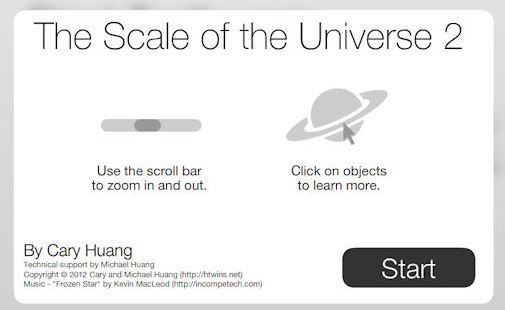
Scale of the Universe 2 is an interactive infographic created by teen twins Cary and Michael Huang. What started out as a class project, ended up being a viral phenomena. While a musical score plays, you can scroll down to tiny particles like quarks & plancks, and scroll out to larger scales that includes nebulae & galaxies. Based off their original creation, this version includes small animations and clickable objects to learn more about them.
Magnifying the Universe
This interactive infographic is created by Number Sleuth and it is similar to the Huang brothers version, except that there is no music and you can start your scale from categories: buildings, animals, mountains, etc. Be sure to click the full screen ‘X’ on the upper right below or access directly on their site.
Copyright 2012. Magnifying the Universe by Number Sleuth.
100,000 Stars
100,000 Stars is an immersive interactive visualization created by the Google Data Arts Team. Its limitation is that it focuses only on the closest stars to earth within our own galaxy. Cool feature: you can click the “Take a tour” option on the top left for an automated tour. Geek feature: you can toggle the color spectral index. Click the image or access here.

Universcale
Universcale is yet another interactive creation to explore scales of the universe. Created by Nikon, it allows you to see the relative sizes of objects by scrolling in a linear manner, allowing you to click the objects along way that provide tidbits of information.

If the Moon Were Only 1 Pixel
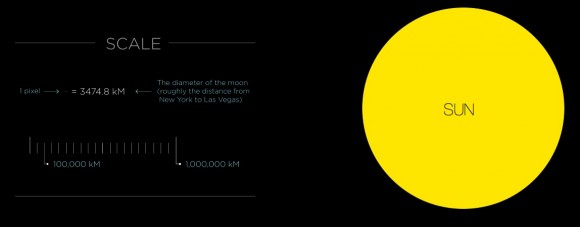
If the Moon Were Only 1 Pixel: A Tediously Accurate Scale Model of the Solar System is created by writer, designer, and artist Josh Worth. This scale model of the Solar System is art itself; without the need of Flash, it uses a horizontally-sliding HTML page that you navigate with your arrow keys, to travel distances between our planets and see the scale of their relative sizes (or you can click/drag the bottom bar with your mouse).