
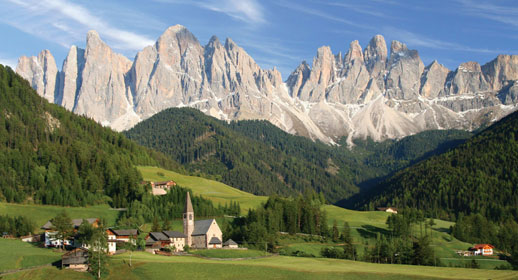
This short visual film about the geology of the beautiful Dolomites mountain range is created by Italian photographer/filmmaker Rolando Menardi. These unspoiled mountains straddle the territory of five provinces in northeastern Italy, forming part of the Southern Limestone Alps. One of its provinces, South Tyrol, is home to the South Tyrol Museum of Archaeology, where one can visit the ancient 5,000-year-old preserved Otzi, the Iceman.
“The surface of the earth is far more beautiful and far more intricate than any lifeless world. Our planet is graced by life and one quality that sets life apart is its complexity.” –Carl Sagan
The stratigraphy of the Dolomites includes Permian to Cretaceous terrains which sit on top of a Paleozoic Basement. Although the sedimentary succession ranges through these periods, the landscape is dominated by the majestic Triassic carbonates. The birth of the Dolomites can be traced back to the womb of Tethys Sea, germinating from its sediments and calcareous deposits. The Dolomites entered UNESCO’s World Heritage List in 2009.

This is a separate video below, depicting the scenic rich Dolomites from the South Tyrol province: