Free (Physical Geology) Video Lecture Series: Earth Revealed

Earth Revealed

“Earth Revealed” is a series of 26 lectures (1/2 hour each) created by Annenberg Media. It is an instructional series lectured by Dr. James Sadd of  Occidental College aimed at teaching/introducing the viewer to the Earth’s physical processes.  Although this series was created in 1992, the material remains accurate. This series has been and still is used in many college introductory to physical geology courses. From my understanding, it is also used for online distant learning by some universities.

Earth Revealed is made accessible to students via DVD at the university’s library as a companion to the textbook, “Physical Geology: Earth Revealed,” since the 3rd-4th edition. The book continues to flourish with a 2012 14th edition and a 15th edition due to be released in 2015. The textbook site still continues to refer to the 1992 Earth Revealed video series.

Annenberg has made the series available for free via online streaming (they also sell the series for $390+) on their site. I have copied the summary of each lecture and modified the video links so that they can be played from this blog post. It is for my collection and for anyone interested in learning the fundamentals of physical geology for free. Each lecture can be played by clicking the VoD icon to the right.  Maximize the video window that opens. Keep in mind, you will be watching video quality from the early 90s 🙂

VOD1. Down to Earth
Surface conditions of the planets Venus and Mars are compared with those of Earth, and scenes of Earth’s living landscapes lead into a discussion of how unique Earth truly is. Major topics addressed in the series, including plate tectonics, natural resources, seismology, and erosion, are introduced in this program.

VOD2. The Restless Planet
Early Greek astronomers believed that Earth was the center of the universe. However, this notion changed dramatically over time, especially after the invention of the telescope. This program traces the development of astronomical theory with discussions of the discoveries of Copernicus, Galileo, Kepler, and Newton. Unique characteristics of Earth are also discussed.

VOD3. Earth’s Interior
Oil wells do more than just produce oil — they serve as windows to Earth’s interior. This program introduces the topic of geophysics, exploring methods of studying what lies beneath Earth’s surface. Geophysicists use seismic wave studies, variations in temperature, magnetic fields, gravity, and computer simulations to create models of deep structures.

VOD4. The Sea Floor
The mysteries of the ocean floor lie hidden under enormous pressure and total darkness. This program looks at the research submersibles and indirect methods used to study the bottom of the sea, providing a glimpse of volcanic activity, formations such as the continental shelf and mid-ocean ridges, and life forms that thrive at extreme depths.

VOD5. The Birth of a Theory
In the 1960s, earth scientists developed the theory of plate tectonics. This program traces the development of plate tectonics, beginning with the contributions and methods of geologist Alfred Wegener. Sea-floor spreading, continental drift, paleomagnetism, and the primordial supercontinent Pangaea are some of the topics covered.

VOD6. Plate Dynamics
This program examines the movement and interaction of tectonic plates, which account for a vast array of geologic formations and phenomena — from California’s San Andreas Fault to the Rift Valley of eastern Africa. The program covers convergent boundaries, subduction, hotspots, and the debate over what drives plate motion.

VOD7. Mountain Building
This program erodes the myth of the mountain as a solid, permanent structure. Animations are used to illustrate the process of orogeny (mountain building) through accretion and erosion, as well as the role of plate tectonics, the rock cycle, and how different types of rock are formed in the course of mountain building.

VOD8. Earth’s Structures
A visit to the Grand Canyon lays the foundation for this exploration of rock layers and deformation. The program covers sedimentation, major structures, the methods used to examine them, and how petroleum may be trapped inside them. It also looks at tectonic force and the different types of stress involved in the formation of geologic structures.

VOD9. Earthquakes
Showing actual footage of earthquakes and their aftermath, this program discusses the forces that fuel these massive events. Faults, waves, and the transfer of energy from the epicenter are explained, and histories of the seismograph and Richter scale are presented. The program also describes devices being developed to study — and eventually predict — earthquakes.

VOD10. Geologic Time
To illustrate the immensity of geologic time, the entire span of Earth’s existence is compressed down to a year. The timeline of major geologic events is superimposed onto the year for a condensed view of Earth’s evolution. A relationship between this timeline and that of life on Earth is established, with fossils and radiocarbon dating playing a major role in the discovery.

VOD11. Evolution Through Time
The fossil record reveals much about the diversity and development of species. This program examines the traces left by early plants, animals, and single-celled organisms and follows the progression of life forms over time. Connections are drawn between atmospheric gases, climate change, rock formation, biological functions, and mass extinctions.

VOD12. Minerals: The Materials of Earth
Minerals have been indispensable to human civilization. This program looks at the variety of minerals, their atomic and crystalline structures, and their physical properties such as hardness and luster. Petrologists’ methods of sectioning rocks are shown, and gems, precious metals, ore excavation, and the value of silicates are discussed.

VOD13. Volcanism
Volcanoes provide clues about what is going on inside Earth. Animations illustrate volcanic processes and how plate boundaries are related to volcanism. The program also surveys the various types of eruptions, craters, cones and vents, lava domes, magma, and volcanic rock. The 1980 eruption of Mount St. Helens serves as one example.

VOD14. Intrusive Igneous Rocks
Most magma does not extrude onto Earth’s surface but cools slowly deep inside Earth. This magma seeps into crevices in existing rock to form intrusive igneous rocks. Experts provide a graphic illustration of this process and explain the types and textures of rocks such as granite, obsidian, and quartz. Once again, plate tectonics is shown to be involved in the process.

VOD15. Weathering and Soils
The Cleopatra’s Needle obelisk in New York City’s Central Park is severely weathered after only 75 years, whereas the dry climate of Egypt has preserved similar structures in that country for millennia. This program shows how weather, climate, chemicals, temperature, and type of substrate factor into rock and soil erosion. Environmental connections are also considered.

VOD16. Mass Wasting
Anyone undertaking a building project must understand mass wasting — the downslope movement of earth under the influence of gravity. Various factors in mass wasting, including the rock’s effective strength and pore spaces, are discussed, as are different types of mass wasting such as creep, slump, and landslides. Images of an actual landslide illustrate the phenomenon.

VOD17. Sedimentary Rocks: The Key to Past Environments
This program returns to the Grand Canyon: its exposed layers of sedimentary rock allow scientists to peer into the geologic past. The movement of sediment and its deposition are covered, and the processes of lithification, compaction, and cementation that produce sedimentary rocks are explained. Organic components of rock are also discussed.

VOD18. Metamorphic Rocks
The weight of a mountain creates enough pressure to recrystallize rock, thus creating metamorphic rocks. This program outlines the recrystallization process and the types of rock it can create — from claystone and slate to schist and garnet-bearing gneiss. The relationship of metamorphic rock to plate tectonics is also covered.

VOD19. Running Water I: Rivers, Erosion and Deposition
Rivers are the most common land feature on Earth and play a vital role in the sculpting of land. This program shows landscapes formed by rivers, the various types of rivers, the basic parts of a river, and how characteristics of rivers — their slope, channel, and discharge — erode and build the surrounding terrain. Aspects of flooding are also discussed.

VOD20. Running Water II: Landscape Evolution
The Colorado River is a powerful geologic agent — powerful enough to have carved the Grand Canyon. This program focuses on how such carving takes place over time, looking at erosion and deposition processes as they relate to river characteristics and type of rock. The evolution of rivers is covered, along with efforts to prevent harmful consequences to humans.

VOD21. Groundwater
Approximately three-quarters of Earth’s surface is covered by water. But most fresh water comes from underground. Topics of this program include aquifers, rock porosity and permeability, artesian wells, the water table, cave formation, sinkholes, and how groundwater may become contaminated.

VOD22. Wind, Dust and Deserts
Land in arid climates is shaped in particular ways. This program shows how deserts are defined by infrequent precipitation and how desertification relates to proximity to the equator, proximity to mountains, and ultimately plate tectonics. Images of landscapes illustrate how wind creates features such as dunes, playas, blow-outs, and even oases.

VOD23. Glaciers
Many of the world’s most beautiful landscapes were made by glaciers. This program shows how, explaining glacial formation, structure, movement, and methods of gouging and accumulating earth. The program provides images of glaciers and glacial landforms such as moraines, and discusses how study of glaciers may help us understand ice ages and the greenhouse effect.

VOD24. Waves, Beaches and Coasts
This program shows the dynamic interaction of two geologic agents: rocky landmasses and the energy of the ocean. Aspects of waves — their types, parts, movement, and impact on the shore — are illustrated. The program also covers shoreline characteristics, currents, sea barriers, tides, and how the greenhouse effect could impact sea level and coastal lands.

VOD25. Living With Earth, Part I
Scenes of San Francisco before the Loma Prieta earthquake introduce this program addressing how humans are learning to cope with earthquakes. Various groups and agencies are studying the San Andreas Fault and the damage caused along its path to better understand how earthquakes ravage the land. Methods of studying earthquakes are reviewed.

VOD26. Living With Earth, Part II
Since the nineteenth century, humans have turned to the Earth for energy sources to fuel their industry. This program discusses where oil comes from, how it is extracted, and how it is converted into energy. The effects of oil drilling and the burning of fossil fuels are also addressed, and the potential of alternative energy sources is considered.

Analysis of the Sterkfontein Cave Site in South Africa

Microstratigraphic Analysis of the Sterkfontein Cave Site

by antonio kuilan

Landscape near Sterkfontein

Abstract

Sterkfontein is an extremely complicated plio-pliestocene site. The cave formation process climaxed ca 25 Ma as the sea that it was submerged in retreated. Avens on the surface washed in debris that later cemented into breccia. In the late 1800s, an Italian miner dynamited the surface of Sterkfontein in search of lime which led to discovery of cave formations and put Sterkfontein on the map of the scientific world. Primate fossils appeared in the mid-30s in discarded breccia by the miners and this generated more interest that led to the discovery of Australopithecus by the late Robert Broom. This ignited archaeological interest that evolved an excavation program that continues to the present day. The site has produced thousands of fauna fossils and stone tools (including Oldowan and Acheulian industries), and hundreds of hominid remains and fragments of fossilized wood with notable hominins: Australopithecus, A. africanus, Paranthropus, P. robustus, and early Homo. Understanding the complex stratigraphy is still a work in progress and recent dating methods that includes magnetostratigraphy and uranium dating are arriving at more precise dates. One controversy was the discovery of blood residue of stone tools but studies by three researchers suggest that the clay-rich environment of Sterkfontein slows down the decay process that will give residues the appearance of being preserved tens of thousands of years later.

Location of Sterkfontein
Sterkfontein Cave Site

To begin to understand the complexities of the Sterkfontein Cave site, one must start back at the beginning to have a working geological knowledge of its formation. The Plio-Pleistocene site of Sterkfontein is located in the Gauteng region about 50km northwest of Johannesburg, South Africa. Around 2.5 billion years ago, this region was submerged under a warm shallow sea that provided the conditions for the formation of sediments that later solidified as dolomitic limestone rock. Through hundreds of millions of years, extensive formations of quartzite and shale formed from other sediments that covered the dolomite as it rested beneath the seabed. Circa 25 million years ago, the sea retreated and geological processes altered the attitude of the strata to dip in a northwestern manner (Figure 1).

figure 1
figure 1

Around 50 m deep under the water table, cavern formations commenced with the calcium carbonate being dissolved out of the dolomite across horizontal planes by the weakly acidic ground water. Later, these cavern formations became sealed air-filled cavities as the water table dropped (Figure 2).

figure 2
figure 2

Slow seeping acidic groundwater continued to work the dolomite, dissolving minerals, and when each drop reached the cave’s ceiling, it precipitated back to limestone, forming elongated stalactites (figure 2) – a process that has taken thousands of years. Eventually, avens opened on the surface above, resulting from the prolonged dissolution of the dolomite along vertical cracks or joints (figure 3).

figure 3
figure 3

Some joints became exposed due to the surface being subjected to erosional processes, which also ended the sealed state of the air-filled cavities (Figure 3). Over thousands of years, earth and rock washed into the cave forming talus deposits that eventually became cemented by dripping lime. Some of the breccia, formed from talus, collapsed from the higher, mature, cave formations above, with some of it returning to returning to its natural, soft state, due to decalcification (Figure 4).

figure 4
figure 4

The excavation of these ancient infills is what yields hominid remains, flora, fauna, and stone artifacts .

In the 1890s, it was Italian miner Guglielmo Martinaglia that first started dynamiting the Sterkfontein surface to exploit the stalactites and stalagmites below for its lime.

Lime prospector G. Martinaglia

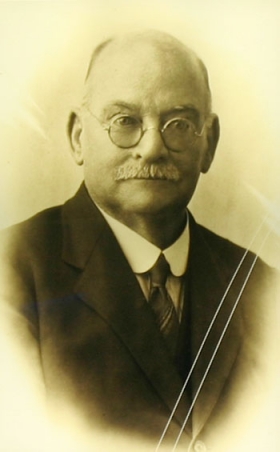
Around the same time, Geologist David Draper from the South African Geological Society attempted to convince the miners to stop mining and preserve the main cave due to its rich geologic content but was unsuccessful. Mining continued throughout the decades, with the area becoming a local attraction. It was the initial blasting by Martinaglia that paved the path to later scientific exploration at Sterkfontein.

Geologist David Draper

Various studies have shown that the Sterkfontein caves with its brecciated infills, talus deposits, surface debris deposited through avens, orientation of deposits, the dissolution of limestone, and the decalcification of lime-consolidated breccias, make the site extremely complex and its stratigraphy difficult to decipher.

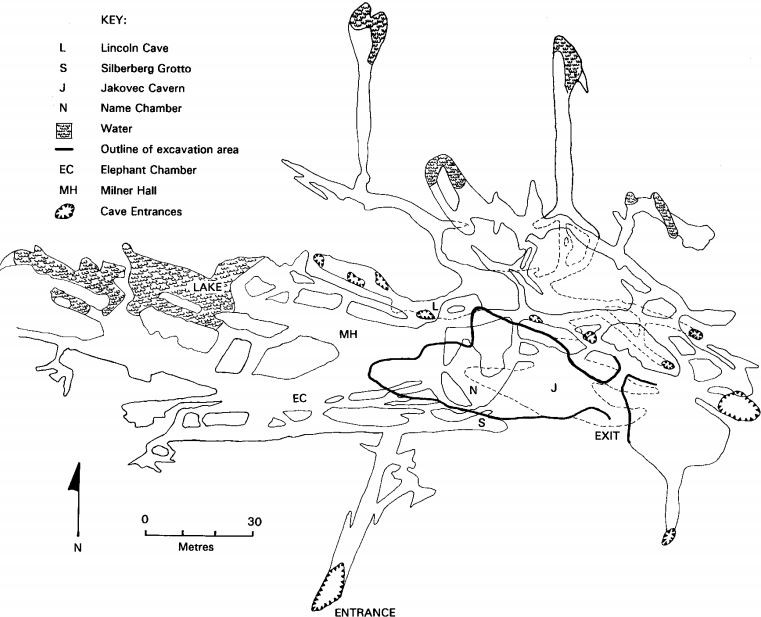
Figure 5 shows an overall diagram of the complexity of the Sterkfontein Caves. The site is divided into the Lincoln Cave, Silberberg Grotto, Jakovec Cavern, Name Chamber, Elephant Chamber and Milner Hall. There are 6 members at Sterkfontein. Geologist Tim Partridge performed detailed studies on the stratigraphy of Sterkfontein and identified six geological divisions of the Sterkfontein Formation that he described as Members 1, 2, 3, 4, 5, and 6.

figure 5
figure 5

These members are shown in a simplified drawing by Ron Clarke in Figure 6; Members 4, 5, and 6 are based on the surface and Members 1, 2, and 3 are underground.

figure 6
figure 6

This Member naming structure continues to be used in scientific literature.

Archaeological Evolution and the Significant Finds at Sterkfontein

The mining at Sterkfontein since Martinaglia blasted the area in the 1890s changed evolved throughout the decades and by the early 1930s large amounts of blasted breccia removed by the lime workers started to reveal primate bones, from which Trever Jones, a student of Raymond Dart, obtained fossil monkeys in 1935 and published the first scientific study of fossils form the site in 1936. Interest kept increasing at Sterkfontein. Other students of Dart introduced Paleontologist Robert Broom, who was 70 years old at the time and searching for ape-man remains at nearby Pretoria, to Sterkfontein in August 1936. A few days later, George Barlow, the lime quarry manager at the time, handed Broom the first hominid fossil from the breccia, Australopithecus. This led to many other discoveries including the most complete skull of Australopithecus africanus in 1947.

Dr. Robert Broom
Dr. Robert Broom

Interest at Sterkfontein was at its maximum and in 1956 Charles K Brain and Anthony B.A. Brink discovered the first early Acheulian hominid stone stools in the breccia dumped by lime workers. After this discovery, archaeologist Revil Mason conducted the first test excavation with Charles Brain in 1956. John Robinson (the late Robert Broom’s trusted assistant) excavated Sterkfontein from 1957-1958 revealing an early Acheulian industry that was later analyzed by Revil Mason. Palaeoanthropologist Philip V Tobias created the full-time excavation program in 1966 at Sterkfontein that has run to the present day without interruptions. Ian Watt surveyed the Sterkfontein Caves and created a greatly extended grid system necessary to record the positions of finds at the site; this grid system was implemented in Tobias excavation program. Alun Hughes headed the Tobias excavation program from 1966 to 1991 and during this time the discovery of hundreds of Australopithecus fossils were credited to him.

Suspended Harris Matrix over excavation site.

Palaeoanthropologist Ronald Clarke has headed the excavation program since 1991, a few years later he was searching through stored boxes containing faunal remains that were excavated in early 1980 from the Silberberg Grotto section of Sterkfontein, discovering leg/foot bones that belonged to one individual. He predicted the rest were embedded in the breccia of that section and based on the cataloged information, he instructed this assistants to search the Member 2 breccia. A short time later in 1997, the rest of the bones (radius, lower legs, left humerus) were discovered, including the first complete skull ever found of Australopithecus, which was later dubbed “Little Foot.” Its species designation is an ongoing controversy.

Dr. Ronald Clarke
Dr. Ronald Clarke
Clarke and assistants.

Over 9,000 stone tools/flakes, thousands of faunal fossils, hundreds of fragments of fossil wood, and nearly 500 hominid fossils (skulls, jaws, teeth, and other skeletal remains) have been found in the entirety of the excavations at Sterkfontein. Members 1 through 3 are mostly partial remains of monkeys and carnivores. Analysis on fossilized wood fragments from the breccia in Member 4 reveal that the area was surrounded by tropical forest trees ca. 2.8 Ma. Australopithecus has been found in the breccias of Member 2 & 4 and in the lower cave, Jacovec Cavern. A. africanus is found in Member 4. Early Homo has been found in StW 53 (an infill between Members 4 and 5) and in Member 5. Paranthropus and P. robustus are also found in Member 5. Member 6 is dated < 200ka and produces primates of modern form. Oldowan and Acheulian tools are found in Member 5.

tool1 tool2
Oldowan tools
Oldowan tools
Acheluian tools
Acheluian tools
One Controversy at Member 5

In 1997, T.H. Loy claimed that he detected blood residues on Oldowan stone tools from the stratigraphic Member 5. This became controversial. It was stated that researchers are unable to describe the mechanism of residue decays, leading analysts who record data to make interpretations that are oversimplified or inaccurate. Peta Jane Jones (2009) conducted a study that directly assessed Loy’s blood residue claim. Jones performed an indepth microstratigraphic investigation into the Member 5 geological matrix that housed the stone tools from Loy’s claims. Jones conducted a battery of chemical tests, including petrographic analysis and pH analysis on the composition of the breccia burial matrix. Jones study suggested that a cave environment with a well-cemented, clay-rich burial matrix, a favorable alkaline pH, and a high soil cation exchange capacity, favors residue preservations over extreme timeframes. Jones summarized that:

  • Stone tools are used multiple times to butcher, leaving thick layer of blood residues on them; as it dries, it secretes into microcracks.
  • Through transport, residues later come in contact with clay and leads to a degree of binding that creates hydrophobic proteins.
  • The artifacts and sediment are transported, and may be deposited through avens, slopes, or other entrances.
  • Organic-mineral complexes are encouraged by large negatively charged surface area and swelling ability of clay sediment; the accumulated proteins with clay are more resistant to degradation.
  • Leaching occurs by rainfall releasing calcium ions from dolomitic rock on top and the solution filters through sediments below as calcite which cements deposits into brecciated infill.
  • Organic material absorbs calcium ions, weak bonds form between calcite and clay surfaces, and the precipitated calcite creates a well-cemented clay/calcite matrix that encloses and protects artifacts and blood residue.
  • A regulated environment is maintained by the breccia matrix that “…is not directly exposed to surficial water and was possibly buried with further compaction from overlying brecciated deposits, protected from detrimental conditions.”
A summary of Jones' work
A summary of Jones’ work

Geeske Langejans (2010) took a step further and performed experimental archaeology by leaving stone tools at 3 different sites for a year to test preservation. Sterkfontein was one site, along with Sibudu, and Zelhem, a site in the Netherlands that act as a control. At Sterkfontein, he left 80 samples; 40 samples inside the cave and 40 samples outside the cave (see Figure 7).

figure 7
figure 7

The 40 samples to be placed inside the cave were further divided: 20 left buried and 20 left on top of sediment. Langejans retrieved the residue samples in the cave 1 year later and found that those that were buried preserved best. Langejans stated that different residues preserve differentially, some better than others; though residue always undergo decomposition, those that are in a dry zone bioactivity undergo slow decay that can take tens of thousands of years, give residues the appearance of being permanently preserved – as long as the environment remains stable. This experiment and the work of Jones and Hopley provide evidence of preservation at Sterkfontein, but can also be used to make predictions of residue preservation at other and future sites.

Dating

Early dating of the Sterkfontein Caves was based on faunal correlation based on changes in dentition and anatomy, followed by later cosmogenic isotope burial ages, uranium-lead dating of speleothems, ESR, and magnetostratigraphy.

Uranium Dating

Pickering (2010) performed dating on young carbonates from open exposures at Sterkfontein, on boreholes that were drilled twenty-five years earlier by Partridge and Watt, and on underground deposits from the caves. Figure 8 shows updated stratigraphic logs with black arrows pointing to the uranium dating. Uranium dating gave the following estimates to the given members:

  • Member 1 = >2.8 Ma
  • Member 2 = 2.6 – 2.8 Ma
  • Member 3 = 2.6 – 2.0 Ma
  • Member 4 = 2.6 – 2.0 Ma
  • Member 5 = < 2.0 Ma
figure 8
figure 8

Interesting to note that Pickering argued for a revised stratigraphy at Sterkfontein, that Pickering “believe” no clastic sedimentation exist between Members 2 and 4 but instead separated by a massive flowstone layer. Most strongly, Pickering claims that there is no evidence that the present cave “…was ever wholly filled up with sediments.” Pickering also note that Sterkfontein is complex including the problem of past mining activity removing material, noting that his interpretation is not absolute, but that stratigraphy at Sterkfontein is “…likely to remain a contentious issue.”

Magnetostratigraphy

One recent palaeomagnetic analysis was published by Herries and Shaw in based on analysis from speleothems in Members 1 through 5. Figure 9 (Herries) depict the location of paleomagnetic samples based on the composite stratigraphy compiled by Partridge in 2000. Two methods of sampling were executed at Sterkfontein by Herries: block sampling and drill coring.

figure 9
figure 9

Figure 10 (Herries) illustrates the magnetostratigraphy for the Sterkfontein Cave. Palaeolatitude (degrees) versus depth (meters) are plotted against: archaeology, hominin fossils, polarity, Members, and the geomagnetic polarity timescale. Key: O = Olduvai event, R = Reunion event, HR = Huckleberry Ridge event.

figure 10
figure 10

Herries (2011) proposed a chart with suggested age ranges based on a combination of uranium, ESR, and magnetostratigraphy data (Figure 11).

figure 11
figure 11
Conclusion

The Sterkfontein Cave is an extremely complicated site. Although continuing work has been conducted since the late 30s at the site, there is much debate about its stratigraphy. Pickering even implied that the Member naming scheme may be limiting since he attempted to revise the stratigraphy without distorting the Member system. The complex infills and other deposition combined with collapsing cave mechanics and chemical weathering, leave the guts of Sterkfontein intertwined. Because of the topographic complexity, it had made earlier to recent dating slightly difficult. The accumulative work of researchers over the decades seem to be revealing precise dates but what is going on inside the cave still continues to be the subject of long arduous work. The site still continue to produce countless finds – perhaps the next one will add another clue to our evolutionary past.

whlsterksterkc1sterkc2sterkc3sterkc4sterkc5sterkc6

References

Creighton, Gabel. Africa South: The Last 30,000 Centuries: Recent     Investigations of Man’s Past in the Sub-Saharan Tropics. Journal of Field   Archaeology. 2: 363-387. 1983

Herries, Andy I.R. and Shaw, John. Palaeomagnetic Analysis of the Sterkfontein Palaeocave Deposits: Implications for the Age of the Hominin Fossils and Stone Tool Industries. Journal of Human Evolution. 2010. 1-17.

Hopley, J. Philip, et al. Speleothem Preservation and Diagenesis in South African Hominin Sites: Implications for Paleoenvironments and  Geochronology. Geoarchaeology. 24 (5): 519-547. 2009

Jones, Jane Peta. A Microstratigraphic Investigation into the Longevity of  Archaeological Residues, Sterkfontein, South Africa. Archaeological Science Under a Microscope. 2009.

Kuman, Kathleen. The Archaeology of Sterkfontein – Past and Present.  Journal of Human Evolution. 27:471-495. 1994.

Kuman, Kathleen, and Clarke Ron, J. Stratigraphy, Artefact Industries and Hominid Associations for Sterkfontein, Member 5. Journal of Human Evolution. 38: 827-847. 2000.

Langejans, H.J. Geeske. Remains of the Day-Preservation of Organic  Micro-Residues on Stone Tools. Journal of Archaeological Science.          37:  971-985. 2010.

Pickering, Robyn. Re-Appraisal of the Stratigraphy and Determination of New U- Pb dates for the Sterkfontein Hominin Site, South Africa. Journal of Human Evolution. 59: 70-86. 2010.

Stratford, J. Dominic, et al. New Stratigraphic Interpretations of the Fossil     and    Artefact-Bearing Deposits of the Name Chamber, Sterkfontein. South African Archaeological Bulletin. 67 (196): 159-167. 2012.

Wilkinson, M. Justin. Geomorphic Perspectives on the Sterkfontein   Australopithecine Breccias. Journal of Archaeological Science. 10:    515-   529. 1983.


Archaeology, Geology, and Science